
A professional fire risk assessment combines an opening discussion, a methodical inspection of the premises and a review of how fire safety is managed. The outcome should be a clear written assessment and prioritised action plan—not simply a certificate or pass mark.
The short answer
During a fire risk assessment, the assessor learns how the premises is used, identifies fire hazards and people at risk, inspects escape arrangements and fire precautions, and evaluates whether existing controls are suitable. After the visit, the findings are recorded in a report with practical, prioritised recommendations.
What happens before the assessor arrives?
A useful assessment begins with an agreed scope. The assessor should understand the address, type of premises, approximate size, number of floors, main use, occupancy and any unusual risks before attending. Complex or multi-occupied buildings may require additional time, information or specialist input.
You may be asked to make relevant documents available, including:
- The existing fire risk assessment and action plan, if there is one.
- Floor plans, occupancy information and details of how each area is used.
- Fire-alarm, emergency-lighting and firefighting-equipment maintenance records.
- Fire-door, compartmentation or other relevant inspection reports.
- Fire-drill, staff-training, false-alarm and incident records.
- The current emergency evacuation plan.
- Information about disabled people or others who may need assistance, handled appropriately and confidentially.
Someone who understands the premises should normally be available during the visit. This may be the Responsible Person, building manager, facilities manager, landlord, managing agent or another informed representative. Our guide to who is responsible for fire safety explains why the legal duty remains with the person or organisation in control.
The assessor will need safe access to the areas within the agreed scope. Locked plant rooms, risers, stores, roof areas, basements, vacant units or sample residential areas should be arranged in advance where they need to be assessed.
What is covered in the opening discussion?
The assessor will usually begin by confirming how the building works in practice. A plan or previous report cannot show everything about staffing, visitors, contractors, vulnerable occupants, night-time use or day-to-day management.
Questions are likely to cover:
- Who occupies and controls each part of the premises.
- Normal and maximum numbers of employees, residents, customers or visitors.
- Working hours, lone working, sleeping accommodation and out-of-hours activity.
- People who may be unfamiliar with the building or require help to evacuate.
- Processes involving heat, cooking, machinery, charging equipment or dangerous substances.
- Arrangements for testing, maintenance, housekeeping, training and drills.
- Any previous fire, near miss, false alarm, enforcement contact or significant defect.
- Planned alterations, changes of use or increases in occupancy.
The purpose is not to catch staff out. It is to make sure the written assessment reflects the real building and the people who use it.
What will the assessor inspect?
The assessor then carries out a methodical walkthrough. The exact inspection depends on the premises and agreed scope, but it normally considers the following areas.
Electrical equipment, heating, cooking, smoking, hot work, machinery, arson exposure and other possible ignition sources.
Combustible materials, waste, stock, furnishings, storage practices and any dangerous or flammable substances.
Occupants throughout the building, visitors, contractors, lone workers and anyone who may need additional assistance.
Travel routes, stairs, final exits, door security, signs, emergency lighting and whether routes are clear and usable.
Detection and alarm, firefighting equipment, compartmentation, smoke control and the apparent condition of fire doors.
Responsibilities, procedures, testing, maintenance, training, drills, contractor management and record keeping.
A general fire risk assessment will usually involve visual inspection of accessible areas and review of available evidence. It is not automatically a destructive survey, a specialist engineering inspection or a full service of every system. If concealed construction, external walls, complex smoke control or another specialist issue needs investigation, the report may recommend further assessment by an appropriately competent person.
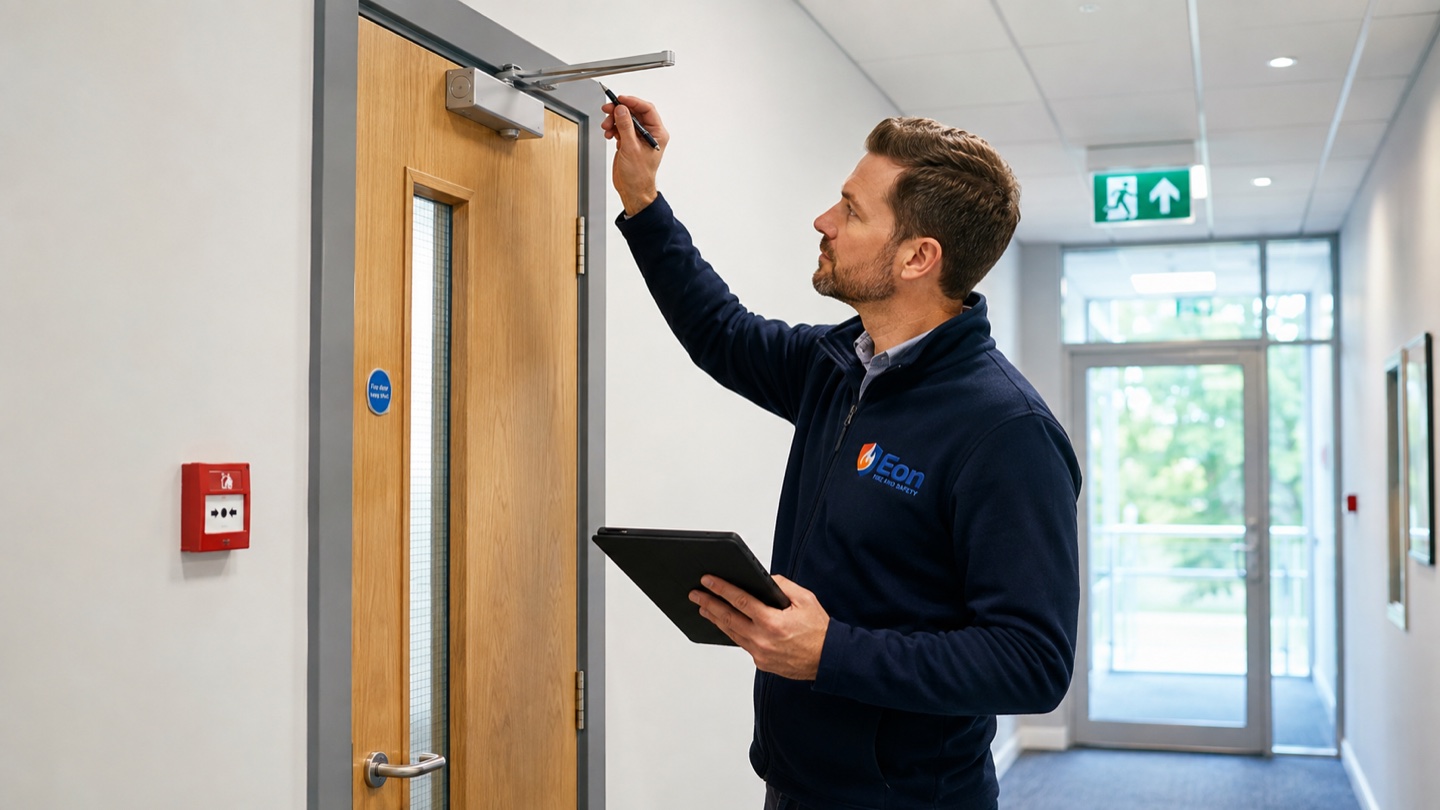
The assessor may examine a selection of doors and other provisions to understand overall conditions. A separate, detailed fire-door inspection may be recommended where the quantity, condition or importance of the doors requires a dedicated scope. Our comparison explains the difference between routine fire door checks and competent inspections.
How does the assessor reach their conclusions?
The Home Office describes a five-step fire risk assessment process. The site visit supplies evidence for each step, but professional judgement is needed to bring the findings together.
- Identify fire hazards.Consider how a fire could start, what could burn and any factors that could help it develop or spread.
- Identify people at risk.Consider everyone who may lawfully be on or near the premises, particularly people who could be more vulnerable.
- Evaluate, remove, reduce and protect.Assess the likelihood and consequences of fire, remove avoidable hazards and determine suitable precautions.
- Record, plan, inform, instruct and train.Document significant findings, create workable emergency arrangements and make sure people understand their roles.
- Review.Keep the assessment current and revise it after relevant changes, incidents or evidence that it may no longer be valid.
The assessment is risk based. One isolated defect does not necessarily determine the overall risk by itself, and identical defects can have different implications in different buildings. The assessor considers how hazards, occupants, escape arrangements, protection measures and management controls interact.
Will the fire alarm or equipment be tested during the visit?
The assessor will normally look at the apparent provision and condition of alarms, emergency lighting, extinguishers and other precautions, together with maintenance and test records. They may ask for a demonstration or functional test where appropriate and agreed.
However, a fire risk assessment is not a substitute for routine alarm testing, emergency-lighting testing, extinguisher servicing or specialist system maintenance. These tasks require their own competent providers and records. Any uncertainty or missing evidence may appear as an action in the report.
How long does the site visit take?
There is no reliable universal duration. Time depends on the building’s size, layout, use, occupancy, complexity, quality of records, number of areas within scope and whether several Responsible Persons share control.
A responsible provider should scope the work rather than promise that every assessment takes the same amount of time. Restricting access or providing incomplete information can also delay the work or create limitations in the final report.
What happens immediately after the walkthrough?
The assessor will usually discuss important observations with the site representative. This is an opportunity to clarify facts, identify existing controls that were not visible during the inspection and explain any matter requiring urgent attention.
Not every recommendation can be finalised on site. The assessor may need to review documents, photographs, plans or guidance and consider how the findings fit together. The written report should therefore be treated as the complete assessment, rather than relying only on the closing conversation.
If an obvious condition presents serious and immediate danger, it should be raised promptly so that the Responsible Person can take appropriate action. The assessor does not assume control of the premises or become responsible for implementing the measures.
What should the final fire risk assessment report contain?
A professional report should be understandable to the people who need to manage the building. Its structure will vary, but it would commonly include:
- Premises details, occupancy, assessor information, date and agreed scope.
- Relevant Responsible Persons and any areas of shared control.
- Information reviewed and limitations affecting the assessment.
- Fire hazards and people especially at risk.
- Findings on prevention, escape, detection, protection and fire-safety management.
- Photographs or location references where they help identify an issue.
- An overall risk evaluation or summary, explained in context.
- A prioritised action plan with proportionate recommendations.
- A recommended review point and reasons for an earlier review.
The action plan is the practical output. It should help the Responsible Person distinguish urgent life-safety concerns from improvements that can be planned over a longer period. Eon Fire and Safety also provides post-assessment action-plan support where help is needed to interpret, prioritise or close findings.
What does a fire risk assessment not do?
Understanding the boundaries avoids false reassurance. A fire risk assessment does not normally:
- Issue a pass certificate or guarantee that no fire will occur.
- Transfer the Responsible Person’s legal duties to the assessor.
- Replace maintenance, testing or servicing of fire-safety systems.
- Confirm the hidden construction of every wall, ceiling, door or service penetration without an agreed intrusive scope.
- Automatically include specialist assessments outside the agreed competence and scope.
- Complete the actions identified in the report.
The assessment is the foundation for managing risk. Its value depends on accurate information, competent work and timely action afterwards.
How should you prepare for a fire risk assessment?
- Confirm the premises, areas and activities included in the scope.
- Arrange access and identify a knowledgeable person to accompany the assessor.
- Gather the previous assessment, action plan, plans and maintenance records.
- Prepare accurate occupancy details and identify people who may need assistance.
- List recent incidents, changes and planned building work.
- Do not temporarily hide normal conditions solely for the visit; the assessment should reflect how the premises is really managed.
- Ask when the report will be delivered and what follow-up support is available.
Ready to understand your fire risk?
Arrange a professional fire risk assessment
Use our online estimator for an immediate guide price or tell us about your building and requirements.
Frequently asked questions
Does the business need to close during the assessment?
Usually not. Many assessments can be completed while a premises operates normally, which also helps the assessor understand real conditions. Access may need to be managed around sensitive, secure or hazardous areas.
Should a manager accompany the assessor?
A knowledgeable representative should normally be available, particularly for the opening discussion and access. They can explain procedures, locate records and answer questions. They do not necessarily need to follow the assessor every minute if suitable arrangements have been agreed.
Will photographs be taken?
Photographs are often useful for recording locations and explaining findings. Any restrictions involving residents, customers, security or confidential areas should be discussed before the inspection.
Will the assessor test every fire door?
A general assessment considers whether fire doors appear suitable and effective within the assessment scope. It is not necessarily a detailed inspection of every door. A dedicated fire-door inspection may be required.
What happens if serious problems are found?
Matters presenting significant or immediate concern should be brought to the Responsible Person’s attention promptly. The final report should prioritise action, but the Responsible Person must decide and implement suitable interim and permanent controls.
How often should the assessment happen again?
The report should recommend a review point, but changes or incidents may bring this forward. Our guide explains how often a fire risk assessment should be reviewed and the events that trigger an immediate review.
Reviewed by Eon Fire and Safety’s ABBE Level 3 qualified fire risk assessor. IFSM Technician #8791 and NFRAR Foundation Registered.
This article provides general information for premises in England. The exact assessment method and scope should reflect the particular building, activities, occupancy and relevant fire-safety guidance.