
Fire Door Inspections in South London and Surrey
Professional Fire Door Inspection Services | Ensuring Your Fire Doors Are Compliant and Fit for Purpose | IFSM and IFE Accredited Assessors
What is a Fire Door?
A fire door is a specially engineered door designed to resist the spread of fire and smoke between different areas of a building. Fire doors are a critical component of your building’s passive fire protection system, working alongside compartmentation to contain fire and protect escape routes.
Unlike ordinary doors, fire doors are tested and certified to withstand fire for a specific period — typically 30 minutes (FD30) or 60 minutes (FD60). When properly installed and maintained, they buy crucial time for occupants to evacuate and for the fire service to respond.
However, a fire door is only as effective as its weakest component. A damaged door leaf, missing intumescent strips, faulty self-closer, or excessive gap around the frame can all compromise the door’s ability to perform in a fire. This is why regular inspection and maintenance is essential.
Why Do Fire Doors Need to Be Inspected?
Fire doors are subject to daily wear and tear. They get propped open, slammed shut, damaged by trolleys and equipment, and their components degrade over time. Without regular inspection, defects can go unnoticed — leaving your building and its occupants at risk.
- Damaged or missing intumescent strips and smoke seals: These expand in heat to seal gaps — without them, fire and smoke can spread
- Faulty or missing self-closing devices: Fire doors must close fully and latch automatically
- Excessive gaps around the door: Gaps larger than 3-4mm allow fire and smoke to pass through
- Damaged door leaves: Holes, cracks, or delamination compromise fire resistance
- Incorrect or missing signage: Fire doors should be clearly marked
- Doors propped or wedged open: Unless held by automatic release mechanisms linked to the fire alarm
- Unsuitable locks or handles: Hardware must be compatible with the door's fire rating
- Glazing issues: Vision panels must use fire-rated glass correctly installed
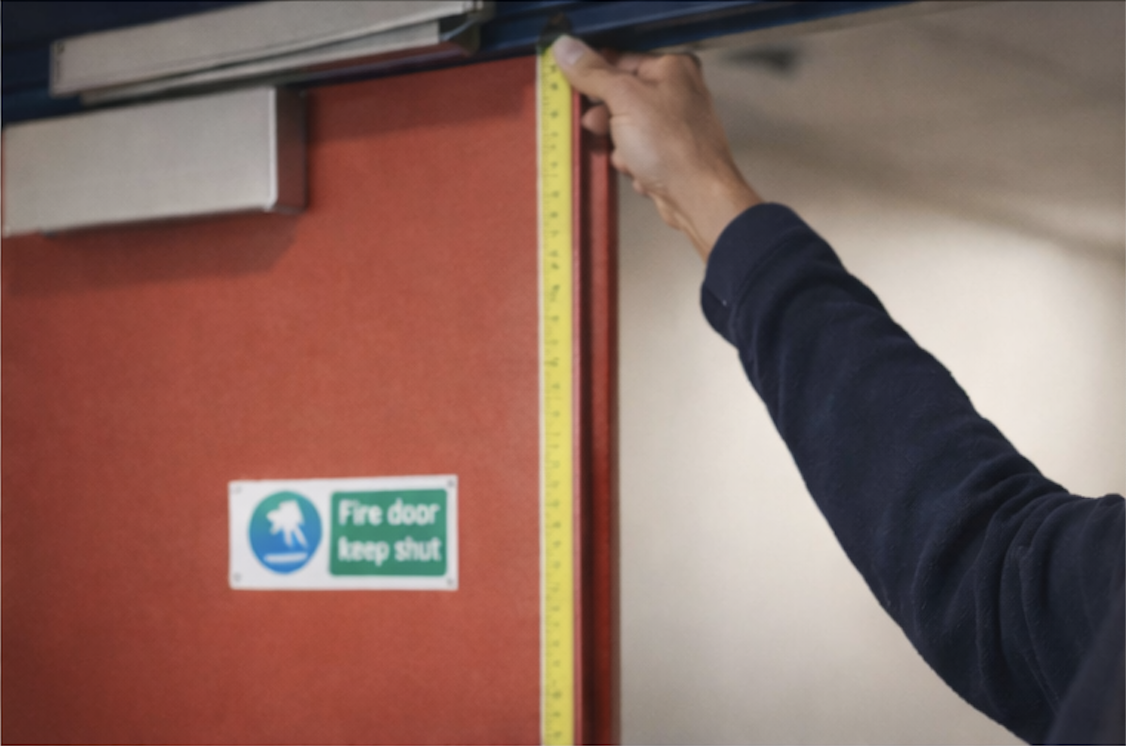
Fire Door Inspection: Legal Requirements
Fire door maintenance is a legal requirement under several pieces of legislation. As the responsible person, you must ensure your fire doors are properly maintained and fit for purpose.
Regulatory Reform (Fire Safety) Order 2005
The Fire Safety Order requires the responsible person to ensure that fire safety equipment and devices — including fire doors — are maintained in an efficient state, in efficient working order, and in good repair.
Fire Safety (England) Regulations 2022
For residential buildings over 11 metres in height, the regulations introduced specific requirements for fire door checks:
- Quarterly checks of all fire doors in communal areas
- Annual checks of flat entrance doors (where the responsible person has access or control)
- Best endeavours to carry out checks where access is not automatic
Building Safety Act 2022
The Building Safety Act reinforces the importance of fire door maintenance as part of the responsible person's duties. It also strengthened the Fire Safety Order's requirements and increased penalties for non-compliance.
British Standard BS 8214:2016
BS 8214 provides guidance on the installation, maintenance, and inspection of fire door assemblies. It recommends that fire doors are inspected at least every six months, or more frequently in high-traffic areas or where doors are subject to abuse.
Who Needs Fire Door Inspections?
Any building with fire doors should have them regularly inspected and maintained. This includes:
Commercial Premises
- Offices and managed workspaces
- Retail shops and shopping centres
- Restaurants, pubs, and hotels
- Industrial units and warehouses
Non-Profit and Community Organisations
- Churches, mosques, and places of worship
- Charities and community centres
- Village halls and sports clubs
Residential Buildings
- Blocks of flats (communal fire doors and flat entrance doors)
- Houses in Multiple Occupation (HMOs)
- Care homes and nursing homes
- Hotels and B&Bs
Public and Educational Buildings
- Schools, colleges, and nurseries
- Healthcare premises
- Libraries and leisure centres
What Does Our Fire Door Inspection Cover?
Our fire door inspections follow a systematic approach, examining every component that affects the door’s ability to perform in a fire:
Door Leaf
- Condition and integrity (no holes, cracks, or damage)
- Fire rating label or plug present and legible
- Correct thickness and construction
Door Frame
- Securely fixed to the wall
- No damage or distortion
- Appropriate fire stopping between frame and wall
Gaps and Clearances
- Gap at threshold (typically max 8-10mm)
- Gaps at head and jambs (typically max 3-4mm)
- Meeting stiles on double doors
Intumescent Strips and Smoke Seals
- Present and in good condition
- Correctly positioned
- No gaps or damage
Hinges
- Minimum of three hinges fitted
- CE marked and suitable for fire doors
- Securely fixed with all screws present
Self-Closing Device
- Present and functioning correctly
- Closes door fully from any angle
- Door latches into frame
Glazing
- Fire-rated glass correctly installed
- Glazing beads and seals in good condition
- No cracks or damage
Hardware and Signage
- Locks, latches, and handles suitable for fire doors
- Appropriate signage (Fire Door Keep Shut / Fire Door Keep Locked)
- No unauthorised modifications

What You Receive
Following your fire door inspection, you will receive a comprehensive report including:
- Schedule of all fire doors inspected
- Individual assessment of each door
- Photographic evidence of defects
- Pass/fail status for each door
- Prioritised remedial actions required
- Recommendations for replacement where necessary
- Suggested review date
Our reports are clear and practical, giving you the information you need to prioritise remedial work and demonstrate compliance to enforcement authorities and insurers.
How Often Should Fire Doors Be Inspected?
The frequency of fire door inspections depends on the type of building and how the doors are used:
Residential Buildings Over 11 Metres
- Quarterly: All fire doors in communal areas
- Annually: Flat entrance doors (where the responsible person has control)
Other Residential Buildings
- Every 6 months: Recommended by BS 8214 as best practice
Commercial and Non-Domestic Premises
- Every 6 months: Recommended by BS 8214
- More frequently: In high-traffic areas or where doors are subject to abuse
High-Risk Premises
Care homes, hospitals, and other premises with vulnerable occupants may require more frequent inspections — potentially quarterly or even monthly visual checks.

Why Choose Eon Fire and Safety?
Accredited and Qualified
Our inspectors hold IFSM (Institute of Fire Safety Managers) and IFE (Institution of Fire Engineers) accreditation. We understand fire door requirements in the context of your overall fire safety strategy.
Thorough and Systematic
We inspect every component of each fire door — not just a quick visual check. Our systematic approach ensures nothing is missed and gives you a complete picture of your fire door compliance.
Clear, Practical Reports
Our reports are written in plain English with photographic evidence. We prioritise defects so you know what needs urgent attention and what can wait. No jargon, no confusion.
Competitive Pricing
We offer fair, transparent pricing based on the number of doors to be inspected. Contact us for a free, no-obligation quote.
Local Knowledge
Based in South London, we understand the specific needs of businesses and organisations in our area. We serve clients across South London boroughs including Croydon, Bromley, Sutton, Lambeth, Southwark, Lewisham, Greenwich, Wandsworth, Merton, and Kingston upon Thames. We also cover Surrey towns including Guildford, Woking, Epsom, Leatherhead, Dorking, Reigate, Redhill, Camberley, Farnham, Staines, Walton-on-Thames, and Weybridge.
Frequently Asked Questions
A fire door inspection is a systematic check of each fire door in your building to ensure it is correctly installed, properly maintained, and capable of performing its function in a fire. The inspection covers the door leaf, frame, seals, hinges, self-closing device, glazing, and hardware.
BS 8214 recommends fire doors are inspected at least every six months. For residential buildings over 11 metres, the Fire Safety (England) Regulations 2022 require quarterly checks of communal fire doors and annual checks of flat entrance doors. High-traffic or high-risk areas may need more frequent inspections.
Yes. Under the Regulatory Reform (Fire Safety) Order 2005, the responsible person must ensure fire doors are maintained in working order. The Fire Safety (England) Regulations 2022 introduced specific inspection frequencies for residential buildings over 11 metres. Failure to maintain fire doors can result in enforcement action and significant fines.
If a fire door fails inspection, we will identify the specific defects and recommend remedial action. Some issues can be repaired (replacing seals, adjusting closers, fixing hinges), while severely damaged doors may need to be replaced. Our report prioritises defects so you can address the most critical issues first.
Building occupiers can carry out basic visual checks between professional inspections — ensuring doors close properly, checking for obvious damage, and reporting issues. However, a thorough inspection by a competent person is recommended to identify defects that may not be obvious to the untrained eye.
The time required depends on the number of doors to be inspected. As a rough guide, a thorough inspection takes approximately 10-15 minutes per door. A building with 20 fire doors might take half a day. We will provide an estimated timeframe when you request a quote.
FD30 doors are tested to resist fire for 30 minutes; FD60 doors resist fire for 60 minutes. The required rating depends on the location and use of the door. Most internal fire doors in commercial and residential buildings are FD30, while doors protecting higher-risk areas or escape routes may need to be FD60.
Our core service is fire door inspection and reporting. We do not carry out repairs or install replacement doors ourselves. However, we can recommend trusted contractors if required and will advise on the scope of work needed based on our inspection findings.
Our pricing is based on the number of fire doors to be inspected. Contact us with details of your building and approximate door count, and we will provide a free, no-obligation quote.
We provide fire door inspections across South London and Surrey. This includes South London boroughs such as Croydon, Bromley, Sutton, Lambeth, Southwark, and Lewisham, and Surrey towns including Guildford, Woking, Epsom, Reigate, and Camberley.
Ready to protect your premises?
Contact us today to book your fire risk assessment or to discuss your fire safety requirements.